
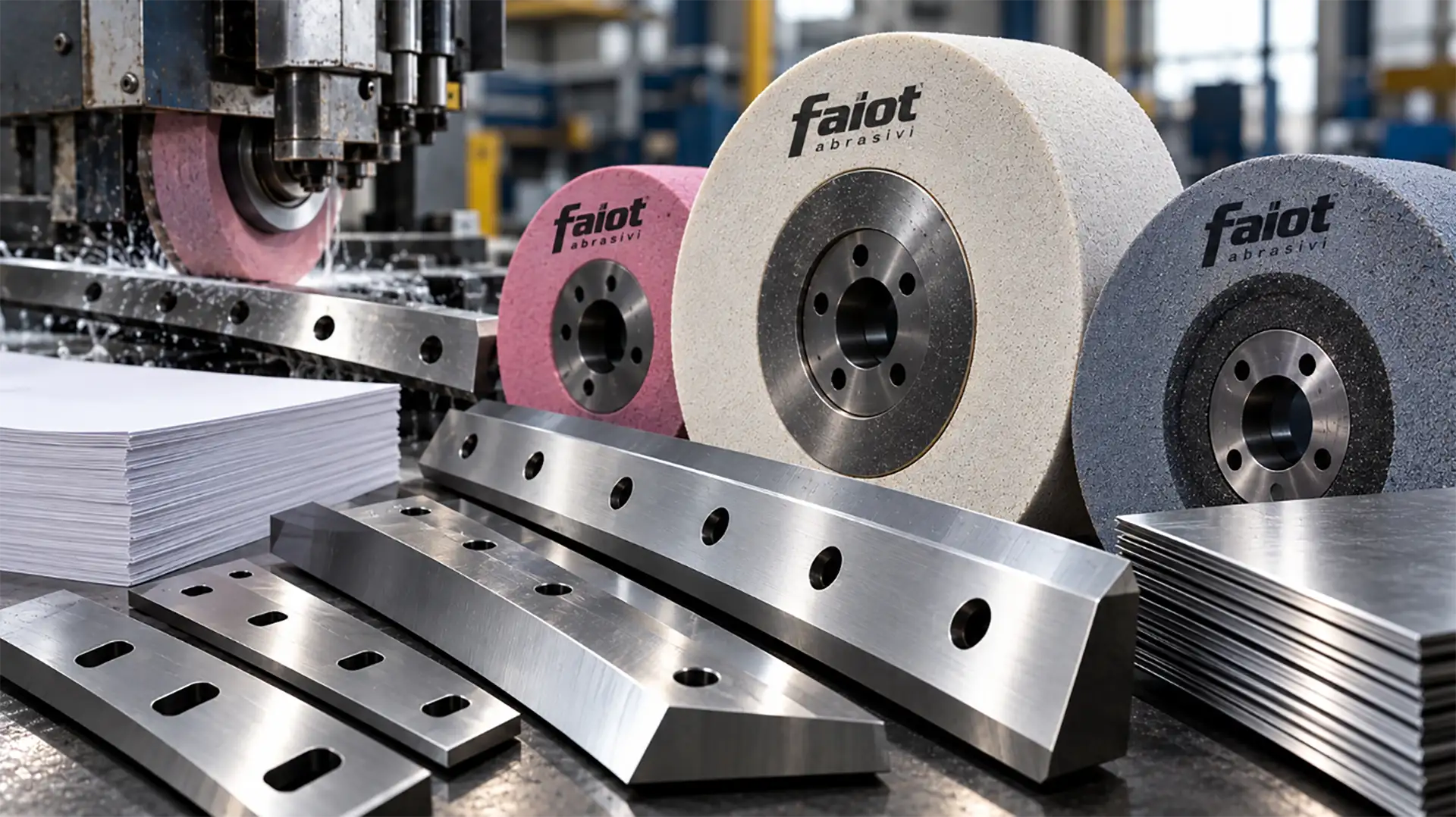
In a paper mill or converting plant, cut quality depends largely on the cutting edge of the blade. A poorly sharpened blade tears fibres, generates dust and frayed edges, increases waste and forces more frequent line stops. Sharpening is therefore not a side task: it is a process step with a direct impact on productivity.
Grinding wheels for knife sharpening are the tools that create that edge. Choosing them correctly means a regular cutting edge, a preserved blade geometry and longer intervals between one sharpening and the next. In this guide we look at which industrial blades are sharpened with grinding wheels, which characteristics matter when choosing them and how to avoid the most common defects.
Which blades are sharpened with grinding wheels
In the paper industry and related processes, the most common are:
- circular blades for slitters and rewinders (longitudinal cutting of reels);
- long knives for sheeters and guillotine cutters;
- log saw blades for tissue paper logs, often sharpened directly on the machine;
- knives and blades for paper converting, packaging, woodworking and similar applications.
Each type has a different material, hardness and edge geometry. There is no single wheel for all of them: the choice depends on the blade and on the sharpening machine.
What matters when choosing the grinding wheel
Abrasive type
Blade steels (carbon steels, alloy steels, high-speed steels) require different abrasives. Aluminium oxide in its various grades is the basis for most steel blades, while specific blends are evaluated for particularly hard or abrasive materials.
Grit size
A coarser grit removes material faster and suits roughing or restoring heavily worn blades. A finer grit gives a more regular edge and a better finish. Often it is best to work in two passes, or to choose an intermediate grit that balances speed and edge quality.
Hardness and structure
A wheel that is too hard tends to load up and overheat the blade; one that is too soft wears quickly and loses its shape. The structure (more closed or more open) affects how well heat and swarf are removed. This is where a clean sharpening and a burnt blade part ways.
Bond: vitrified or resin
Vitrified bonded wheels hold their profile well and grind cool, making them suitable when the edge geometry must be precise. Resin bonded wheels are more elastic, withstand shocks and vibrations better and are often used for on-machine sharpening. We covered this topic in our article on the difference between vitrified and resin bonded abrasives.
Wheel shape
Depending on the sharpening machine, cup wheels, dish wheels, straight wheels or abrasive segments are used. Shape and size must match the machine and the required sharpening angle.
The most common sharpening problems
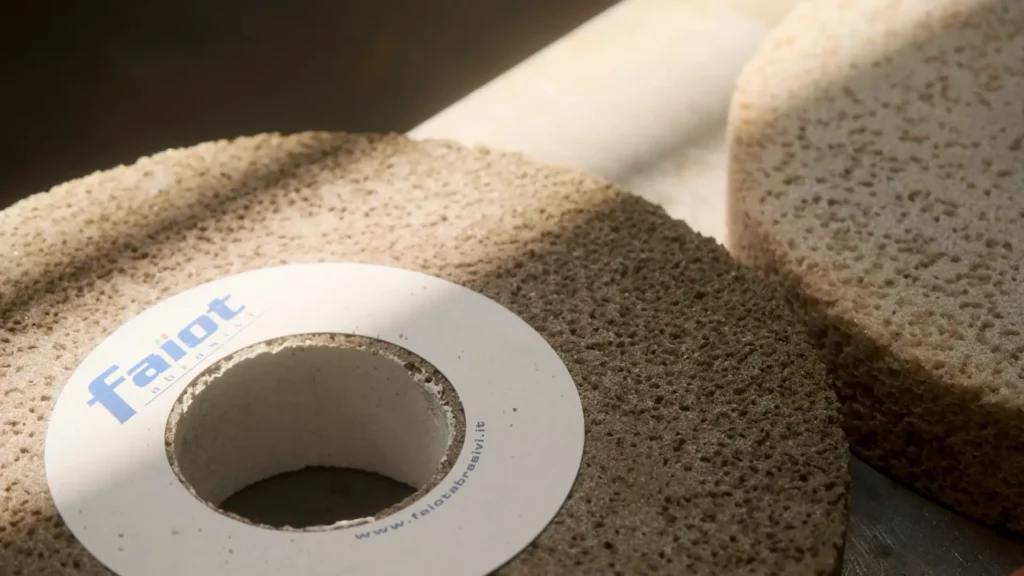
- Burns on the cutting edge: heat alters the temper of the steel and the edge lasts much less. They usually point to a wheel that is too hard, a grit that is too fine or excessive stock removal.
- Irregular or serrated edge: this may come from a worn or undressed wheel, vibrations or an unsuitable grit.
- Loss of geometry: the wheel wears unevenly and the edge angle changes from one sharpening to the next.
- Excessive wheel wear: often a sign that the wheel is too soft for the application.
Many of these problems are also solved by correct dressing: a regularly dressed wheel keeps its cutting ability and its profile. You can find our grinding wheel dressers in the products section.
Custom grinding wheels for your sharpening machine
FAIOT manufactures vitrified and resin bonded wheels to customer specifications. For industrial blades, this means the abrasive, grit, hardness and shape can be adapted to the blade and to the machine you use, instead of adapting your process to a standard wheel.
You can start from the wheel you use today: send us a photo, the code printed on its label or its data sheet, together with information on the blade (material, size, type of cut) and the sharpening machine. Our technical department will assess whether the result or the wheel life can be improved.
Frequently asked questions about blade sharpening
How often should an industrial blade be sharpened?
It depends on the material being cut, the volumes and the line speed. Signs not to ignore are increasing dust, frayed or burnt edges and higher cutting effort. Recording the intervals between sharpenings helps you understand whether the wheel is performing well.
Is a vitrified or a resin bonded wheel better for sharpening blades?
A vitrified wheel is preferable when profile accuracy matters and cool grinding is needed. A resin bonded wheel is suitable when there are shocks, vibrations or sharpening directly on the machine. The final choice depends on the blade and the sharpening machine.
Can you make a wheel identical to the one I use today?
Yes. With the code on the label, a photo or the data sheet we can manufacture an equivalent wheel or propose an improved version for your application.
See also our grinding wheels for professional slicing machines and our range for industry, or contact us for technical advice.


